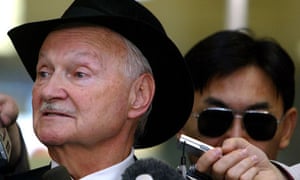
Photograph: Wilson Chu/Reuters/Corbis
Leo Hickman
Former UNEP boss and environmentalist Maurice Strong's interview with Leo Hickman
June 23, 2010
What's your reaction to how your name has been used and abused over the years?
I've got used to criticisms and, naturally, I try to make sure I
don't listen to the more extreme ones because most of the people who
have taken their rightwing extremist view of my life are people that
I've never met. Most of my supporters are people who actually know me. I
just continue to do the best I can and I don't bother to try and
respond to every little bit because the best response is just to keep on
doing what you think is right.
Is this a phenomenon that has happened over the past decade
or so during the internet age, or have you attracted criticism all your
career stretching back to the 1960s?
Way back when I headed the
Stockholm Conference on the Environment
in 1972, I was roundly criticised then. I learn something from
criticism because when it comes from sources you respect you always
examine it and learn. However, the extreme criticism and attacks
exclusively come from people I don't know who have an ideological basis
for their criticism, and, most often, very little factual basis. I
remember years ago the rightwing magazine in the US, the
National Review,
had me on their cover saying something like Maurice Strong is not a
household name, but it perhaps the most dangerous person around, but
they didn't interview me or anything. But I've had my positives too.
Just recently I was in the Netherlands receiving the
Franklin Roosevelt Freedom award.
Some of the criticism, particularly in this internet age, can be like a virus, going completely unchallenged…
If I spent my time responding to it I'd be doing nothing else. The
best thing is just to keep doing what you think is right. I have a
website
for people to get some factual information about me. That is a type of
response, I suppose. Anyone who is seriously interested in me would
usually do a little more homework and realise that the extreme
criticisms are almost exclusively ideologically based. And they don't
bother with facts, they just distort or misrepresent the facts. They
haven't silenced me.
Are you now retired?
I passed retirement age at the UN long ago. I left after the role I
was in most recently which was Kofi Annan's representative in the North
Korean issue. But North Korea withdrew their support for the UN and,
incidentally, I drew some negative comments about why I left the UN,
too. But it just happened that my contract expired and I was already
over retirement age.
So there's nothing in the allegations about your involvement in the oil-for-food scandal?
There was lots of controversy about it, but very little attention was
paid when it become clear that I didn't [have any involvement]. I had
nothing to do with the oil-for-food scandal and there was an
enquiry
that made this clear. But I did have a relationship with one of the
people involved with helping me on North Korea, who came from North
Korea itself. That gave rise to some controversy and then when there was
a report on it that made clear that I had not done any of those things
there was very little publicity for that.
I am retired from all my
official roles, but I am still very active. I have close relationships
at the UN. I don't have any role at the UN, but I'm still quite
cooperative with a number of UN activities, in particular to China and
that region. I don't have any government responsibilities or formal
role. I continue to be active, though.
Have you wound down your business interests?
I don't do very much. My son is the main shareholder of my company
and I help him explore some of those opportunities that are related to
things I know about, such as energy and the environment. But I'm active
because I can't think of anything else to do in my so-called retirement.
A lot of the criticism you seem to attract is founded on the
belief that, via your extensive portfolio of business interests and
bureaucratic roles, you are somehow plotting to establish a new world
order. How do you respond to this accusation?
I think it exaggerates my influence, my power and my intention.
Anyone who wants to look at the record over the years can see that I've
been subjected to that kind of criticism, but I've always made it clear
that I do not believe that global government is either necessary of
feasible. What I do believe is that we need a system of global
governance through which nations can cooperate and deal with issues they
cannot deal with alone. Maybe that statement is too sophisticated for
some but it shouldn't be.
The ultimate example is climate change. I
prepared a piece recently on what I call the "Survival Agenda", pointing
out that the UN agenda has something like 150 items on it and it is
impossible to get an item off the agenda due to the constituencies that
keep them on there. However, many just don't need to be on there. They
can be dealt with by other organisations, or are no longer relevant
compared to when they were put on the agenda. What we need is to give
special priority to those issues that affect our actual survival and
I've boiled this down to about seven issues. We've got to realise that
we blithely assume that life will continue no matter what because it
always has. But it's not correct that it always has.
Look at the history
of planet earth – there's only a minute moment of time when the
conditions have been conducive to human life. We are literally altering
those conditions and my motivation is to alert people to this. I believe
that we need a degree of cooperation on these issues that goes beyond
anything we've ever seen before. During a war we get a lot of
co-operation, but we also get a lot of rivalry. In the second world war,
nations co-operated. There are examples of co-operation during periods
of special need. But things are happening now that could really affect
the future of humanity and that's what drives me. It doesn't mean I'm
right about everything, but that is my purpose.
A common cry among your critics is that you are a socialist, a
communist. Your links to China and North Korea give rise to that view
with some. This, they argue, is all part of some secret agenda to create
a totalitarian, unelected world government. Is this something you
recognise? Are you – or have you ever been – a communist?
I've certainly never been a communist. [Laughs.] It doesn't mean that
I don't look critically at all systems. The capitalist system has
proved itself not able to deal with all of society's problems. In terms
of socialism, yes, I've been accused of that. My belief is that the
purpose of economic life is to meet the social needs of people.
My kids
sometimes ask me: "Are you a socialist or a capitalist?" I'm a socialist
only in the sense that I believe that the purpose of economic life is
to meet the social needs of people. I'm a capitalist in that I believe
that's the best way to do so. Capitalism is not an end in itself but a
means of creating and managing wealth to help meet social objectives. To
me some people define socialism as the ownership of enterprises by
governments on behalf of society. Well, sometimes that is very
necessary.
In Canada, we've never had a socialist government at the
federal level, but we've had state corporations, or what we call crown
corporations. There are times when every government has state
involvement in the economy. In the US, take a look at the single biggest
industry – the defence industry. It is very much state-controlled. I
believe that the government is actually a very poor owner of enterprise.
I've run enterprises in Canada that were owned by government and never
believed that government was the best owner of enterprise.
Is the concept of a free market, given the environmental challenges we face, a dangerous concept for humanity?
It's not free and never has been. Just look at the level of subsidies
that every government provides. Even today, governments continue to
subsidise fossil fuels or other things that are environmentally
counter-productive. The market economy has seldom ever been free and
we've seen recently the dangers of an unregulated, unrestrained market
economy. I think even those who believe in the market economy must
accept that it produces some unwelcome by-products and economic winners
and losers. It demonstrates that a totally free market economy simply
isn't workable.
So an ever freer market is a wrong-headed goal in your view? And increased regulation is preferable?
Up to a point. There are extremes of regulation. There has to be a
balance. The democratic system, in theory, permits this constant
re-examination of this relationship between government and enterprise.
Given your understanding of China, what in your view is the better model in the decades ahead – the Chinese model or the Western model?
I don't think there is any perfect model anywhere. We know already
that the US model is not working. With the bail-outs and takeovers some
of the US's main companies are now controlled by the government. We know
that pure capitalism hasn't worked. In China, they have used their
system – which they call a socialist market economy – quite well to
achieve their objectives. It's also in a continuous process of
evolution. I've had a working relationship with China nearly all my
adult life. I've seen the remarkable progress they've made and are still
making. They're quick learners. They tend to be among the best in terms
of business and industry. They have learned how to use the methods of
capitalism to meet their own goals of socialism. China is among the best
managed countries today. Not perfectly managed, of course
Where would you instinctively rather live? In China, or in the US or Canada?
I've
spent a lot of time in China and, with my environmental interests,
China is about as good a place to be at the moment. China was pretty
slow at the beginning. [The environment] was a side issue compared to
the economy. But China has now recognised that undermining the
environment is one of the risks to development. They have become very
environmentally minded.
After the Copenhagen summit there were lots of accusations that China had pulled the rug out from any agreement…
I was there, but didn't have any influence. That is a lame excuse for
the West. China is actually doing more than most other countries in the
world to reduce its emissions. For example, its automobile emissions
standards are tighter than those of the United States. The problem is
the economy is growing so fast. The Chinese will continue to do more on
their own emissions than an international agreement asks them to do, but
they are not prepared to do them under an international agreement
unless and until those who created the problem in the first place, and
brought us up to these thresholds of danger, are doing what they've got
to do. China's position is very consistent.
What most people missed
about Copenhagen was there was no agreement in prospect. But what it did
do is underscore that China must be accorded the kind of political
status that its economy now demands. It's interesting that the final
statement at Copenhagen was a statement between two countries – China
and the US. That in itself is very significant. China has its own
internal dangers, of course, but it has never been one to take over its
neighbours. It has boundary disputes. It could easily overrun its
neighbours, but it doesn't do that and I don't think it is likely to.
But China is on track to be the largest economy in the world and, with
it, it has a growing political influence.
Does this please or displease you?
I would say neither of those things. It's a perfectly proper
objective for it to pursue. It has already lifted more of its own people
out of poverty than any other single nation. Whether it will work in
the future, as it has done in recent times, I'm not sure, but I don't
see any signs that China increasing its power is a great threat.
It sounds as if your heart and sympathies are more with China at the current time than with the West. Is that correct?
I wouldn't say that. I'm a westerner, but I believe that the rise of
China is good. It's not a danger and it will be a benefit to create a
little more balance in the world where it's not dominated by one
country. The US will continue to be a major force in the world, and
that's good, but it's not going to be exclusively dominant as it has
been in the past. The rise of China, and others in Asia, means the
centre of gravity in world geopolitics has now moved towards Asia. My
sympathies are with the East to the extent that I believe that it's
inevitable – and should be good – that the power structure of our world
community is accommodating of the fact that Asia is the largest region
in economic and population terms. I can see how it could go wrong, too,
but Western leaderships haven't always provided the ideal world we all
hoped for. We are still a minority in the west. We can't continue to
have it all our own way.
One of the strongest criticisms that you face is that,
because you have had a varied career involving business interests and
roles at the UN, you somehow created the climate change issue to
profiteer from your business interests via, say, cap-and-trade and the Chicago Climate Exchange. Or that it is all a Trojan horse for you to advance your political objectives. How to respond to this?
It shouldn't take anyone too long to understand that it would be
pretty difficult for a single person to mount a conspiracy that involves
most of the world's [climate] scientists and to get them all to join
this conspiracy. I'm not a scientist, but I've been close to science and
seen that scientists don't reach consensus very easily. There's a
tremendous process of dialogue and differences. To see climate
scientists reach the level of consensus that they have is a major thing
and couldn't be the result of a conspiracy that one person could ever
engineer.
And what about the idea that you are somehow profiteering
from climate change? That it's a device for you to make money through
cap-and-trade?
I was on an
MIT
panel on climate change in 1968, I think it was, before the Stockholm
Conference. But I was lucky enough to have already made enough money
from business at that time. It's true that I do get a modest fee from
Chicago Climate Exchange, which I helped
Richard Sandor
to found, because I believe the cap-and-trade system, while not
perfect, is one of the best ways to ensure that people have the
incentive to reduce their emissions at the lowest cost. That's a long
way from suggesting that I could invent the climate change issue to make
profit. People call me very rich. I'm rich in experience, but most of
my money has always been spent on the causes I'm interested in. No one
should feel sorry for me for being poor, but I'm certainly not very
rich.
You're painted as this billionaire figure who strides all
these global institutions reaping profits from the so-called
cap-and-trade "scam" and your interests in China. Do you just laugh this
off?
Well, it's just not true. You can check my credit report and see that
I'm credit worthy - but just barely [laughs] - and I've never been
anywhere close to being a billionaire. Also, it's never been my main
purpose in life. I have business interests, but they are pretty modest
and I believe that business has to contribute to the solutions. To do
that, they have to be profitable. If people think I shouldn't have ever
made a living, then perhaps I should have just passed the hat around to
keep my affairs going. But I think if you look at my business record you
will see that not everything I have ever done has been successful, by
any means, but I have fought to contribute to the solutions of these
problems.
Will the BP disaster in the Gulf of Mexico help President Obama push through his climate-change legislation?
I don't have an inside track, but I think it could help and probably
should help. But the oil industry has lobbyists and the power of money
has tremendous influences. No other industry has more than the oil
industry. It's a good industry and I was in it myself. I was jeered when
I set up Canada's national oil company –
Petro-Canada
– because I made every proposal that came to management have to have an
environmental assessment. People in the industry at that time laughed
at it and that was another source of criticism for my crazy ideas. The
oil industry is very important, but it, too, has its excesses and the BP
disaster is demonstrating the tremendous consequences of its excesses.
We have to move away from oil now – and are at the very early stages of
doing so – not because the oil is running out, but because of the
economic and environmental consequences.
Some of your critics claim that you are part of a shadowy
elite who gather together and work out how to run the world. Your name
has been linked to the Bilderberg Group, the Illuminati, and, with your connection to the Rothschilds on the record, the "Jewish banking conspiracy". What are your connections to these groups?
I have got lots of connections, but they're not among them. I've
never been a member of the Bilderberg. I don't have any special
relationship with the Rothschilds. I knew
Edmund Rothschild
at one stage. He's passed away now, but was a very creative fellow who
took an interest in Canada. I don't think I've ever done a piece of
business with the Rothschilds. I've been on various foundations: the
Rockefeller Foundation, and I worked with
Ted Turner in helping him to set up the
UN Foundation.
But I got off most of those things because I got a little older and
attending all the formal meetings was difficult physically because I've
had health problems. What was the other one?
Illuminati - a group that has its origins in 17th Century Bavaria and is said to be planning a new world government.
[Laughs] Well, I've certainly never had any contact with anyone from
that organisation, or that I knew was connected to that group. Maybe
someone I knew had a connection with it, but I certainly don't have any
relationship with it. And I'm not in favour of a world government, as
I've said. It's not even feasible. I do believe that governments have to
work together. That's one of things that really concerns me about the
future. I really do believe that our future is in doubt.
So are you pessimistic about the state of the world?
Analytically, I'm pessimistic. I believe the odds are against us for
making the changes we need to make in time. But, operationally, I'm
optimistic because I believe that it is still possible. Tougher the
longer we delay it. That's why I'm trying all these things because I
believe we should still be trying as long as it is still possible. My
pessimism is based on whether I think we will actually make these
changes. At the Rio Summit, which I ran, a group of enterprises prepared
a report called "Changing Courses". These were not environmentalists,
they were CEOs of major companies and they said
our present industrial
civilisation is not viable unless it changes course. That was back in
1992.
The need to change the course – not to replace it with some
communist system – on which we are now embarked was absolutely
imperative way back then. Now we have more companies agreeing with us,
but we also have more opposition. I do believe that we are at risk.
Your name is often associated with terms such as eugenics
and population control. What is your definitive position on the human
population? Do we need to radically reduce the number of people on this
planet? If so, how?
There is no question that growth in the world population has
increased the pressures on the Earth's resources and life-support
systems. Now that doesn't mean that the Earth can't support this number
of people. There are much more stringent and disciplined ways of
supporting the increase in population. The increase in population is
occurring today mostly in countries without the resources to look after
these populations.
China's
one-child policy
is not a perfect policy by any means, but, on the other hand, how do
you control growth in your population? China has done a remarkable job
in increasing the well-being of one of the largest populations in the
world, but it's not easy.
There's no question that if you look at the
growth in population and the growth of the economy that the pressure on
the environment and resources of the Earth have come not from the
increase in population, but rather the impacts of the existing
population.
All the people on the Earth aspire to a better life.
If all
of them enjoyed the same patterns of consumption that we in the West do,
then we would have an unsustainable situation, and we're actually on
the way to that now. We are in a situation that is unsustainable. In
some of the densest city states, such as Singapore and Hong Kong,
you
see that it's possible to have a decent life, but only by reaching out
to the rest of the world for supplies and support.
So they are
financially successful, but they require a disproportionate share of the
world's resources. On a global basis, that would inevitably create an
unsustainable world.
So, with a global population approaching 7 billion and
predicted to reach 9 billion by 2050, do we just let this rise happen,
or, in the West, do we have to start thinking along China's lines by
introducing rules and regulations about how many children people can
have?
There is quite a lot of evidence to suggest that China's one-child
policy hasn't been the only form of population control in that country.
As the economy helps people in their lives, they tend to have fewer
children.
So one child in the US, could equal the consumption levels of 10 children in Africa or India?
That's what I believe.
It may be possible that the Earth can sustain a
larger population, and seems inevitable with current trends, but it
will require better constraint and discipline. It will be hard to
enforce, therefore. The increase in population will create a huge
dilemma and sources of conflict. For example, population growth in
places like Europe used to be balanced by emigration, but today the
borders of the world are closing and the pressures on Europe, for
example, will grow.
The combination of population growth and the growth
in consumption is a danger that we are not prepared for and something we
will need global cooperation on.
This is the toughest issue of all, surely. How do you go to
someone - unless you live in a totalitarian government such as China's -
and say to them that they must limit the number of children they have?
Nature will provide solutions much tougher than we could ever provide
if we don't do something ourselves. Secondly, I was deputy minister in
the Canadian government at a very young age and I made a speech in
Canada in which I said that,
with a growing global population, we will
have to recognise that having children is not just a personal issue but a
societal issue and at a certain point we may be faced with a need to
have a permit to have a child. My minister was getting all sorts of
calls from archbishops saying, "what is he saying?" I had to explain
that I wasn't advocating this, just that this is what might happen if we
don't find better ways of doing it. That was controversial and I've
been used to controversy ever since. Over the years, I've also noticed
that this is one way of getting attention. For example, you'd probably
never heard of me if people weren't always attacking me. It is, perhaps,
a peripheral benefit that the attacks call attention to the issue.
You don't lose sleep when Glenn Beck dedicates a show to attacking you?
You know what? I haven't actually seen that show. But we wouldn't be
having this conversation if he hadn't attacked me. I'm never going to be
immune from criticism. I've always had lots of it and the internet has
given it a proliferation of dissemination. I don't respond to it all,
but I listen to it. My family gets irritated by it, but it's something
that's been part of my life for so long that at my age I'm
philosophical. I concentrate on the positives such as being honoured
with a professorship seven or eight times. I could just fade away and,
at my age, to some degree I am, but I'm not going to fade away any more
than I have to.


